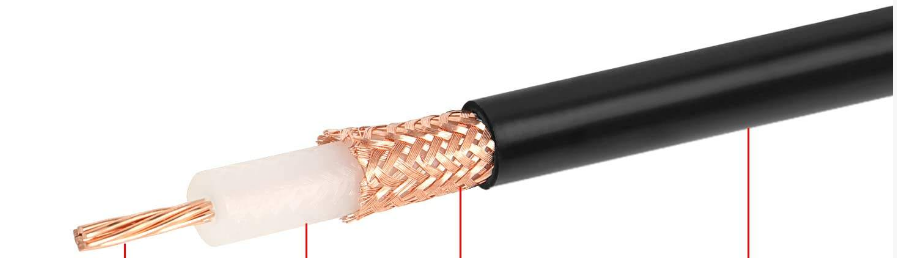
Two guitar cables can look almost identical from the outside.
Same length.
Same color.
Same plug style.
But once you cut them open, the internal construction can be very different.
For distributors, wholesalers, and OEM buyers, this matters because cable performance is not determined by appearance alone. Conductor structure, insulation material, shielding design, and outer jacket all affect how the cable performs, feels, and fits a specific market position.
1. Conductor: Where the Signal Starts
At the center of the cable is the conductor.
In this AMP001 construction, the conductor uses:
18/0.12 CCAM
The stranded structure helps carry the guitar signal while keeping the cable flexible enough for normal stage and practice use.
For buyers, conductor construction is one of the first things worth checking when comparing two cables that may look similar externally.
2. PE Insulation: More Important Than It Looks
Around the conductor is a transparent PE insulation layer.
Specification:
Ø2.2 ± 0.05 mm
Its main job is to separate the signal conductor from the shielding system.
But insulation is not only about physical separation. The material and dimensions also influence the cable’s electrical characteristics.
This is one reason why two cables with a similar outside diameter may still have different internal specifications.
3. Conductive Aluminum Foil: The First Shielding Layer
The next layer is conductive aluminum foil.
Thickness:
Less than 0.05 mm
This layer provides additional protection against external electromagnetic interference.
For instrument cables, shielding is especially important because the cable may be used around amplifiers, pedalboards, lighting systems, power supplies, and other electronic equipment.
4. Spiral Shield: Protection Without Making the Cable Too Stiff
Outside the foil layer is a second shielding structure:
36/0.12 CCAM Spiral Shield
The spiral shield adds another layer of signal protection while helping the cable remain flexible.
That balance matters.
A cable can have strong shielding, but if the construction makes it too stiff, it may not feel right for guitar players during everyday use.
This is why shielding should not be evaluated only by asking:
“Does it have shielding?”
A better question is:
“What type of shielding does it use, and how is it constructed?”
5. Flexible PVC Jacket: What the Customer Actually Touches
The outside layer is the flexible PVC jacket.
Overall cable diameter:
Ø6.3 ± 0.2 mm
This is the part the end user sees and handles every day.
The jacket affects:
-
- Overall product positioning
For distributors, the jacket is especially important because this is where technical construction and retail presentation meet.
Dual Shielding: Why Use Two Layers?
This cable uses:
Conductive Aluminum Foil + 36/0.12 CCAM Spiral Shield
Using two different shielding layers can provide broader protection while maintaining the flexibility expected from an instrument cable.
This kind of internal construction is usually invisible to the end customer.
That is exactly why buyers should understand what is inside before comparing products only by price.
Why Two Similar-Looking Guitar Cables Can Cost Differently
When buyers compare guitar cables, it is easy to focus on visible features:
But much of the cost difference can actually come from inside the cable.
Differences may include:
-
- Number of shielding layers
So when two cables look almost the same but have different prices, the right question is not always:
“Why is this one more expensive?”
Sometimes the better question is:
“Are the internal specifications actually the same?”
For OEM Buyers, Start With the Application
There is no single cable construction that is right for every market.
A distributor may need a cable focused on:
-
- Entry-level retail pricing
That is why OEM cable development should start with the intended market and target price — not simply by copying the outside appearance of an existing cable.
AMP001 Construction Summary
Conductor: 18/0.12 CCAM
Insulation: Transparent PE
Insulation Diameter: Ø2.2 ± 0.05 mm
Shield 1: Conductive Aluminum Foil
Shield 2: 36/0.12 CCAM Spiral Shield
Outer Jacket: Flexible PVC
Overall Diameter: Ø6.3 ± 0.2 mm
Available Lengths: 3m / 6m / 10m
Available Colors: Red / Yellow / Blue / Green / Purple / Black
Looking for a Different Cable Specification?
For OEM projects, the internal construction does not have to stay the same.
Depending on the target market, conductor, insulation, shielding, jacket diameter, plug type, cable length, and color can all be adjusted.
Tell us your target specification, application, or price level, and we can help develop a suitable cable construction.